Property taxes in Fayette County, GA are calculated using Georgia’s 40% assessment rule. Your home is assessed at 40% of its fair market value, and millage rates are applied to that amount. On a $500,000 home in 2025, annual property taxes range from approximately $5,280 in unincorporated Fayette County to $6,608 in the City of Fayetteville, depending on which city or town you buy in. Senior homestead exemptions can dramatically reduce that bill, including a 100% school tax exemption for qualifying homeowners age 65 and older. House Bill 581 (the Save the Homes Act) now caps annual assessment increases to the rate of inflation for primary residences with a homestead exemption.
By Daphne Bousquet | June 2, 2026
Property taxes are one of the most underestimated costs in a home purchase — and in Fayette County, they vary more than most buyers expect.
The difference between buying in unincorporated Fayette County and buying inside the City of Fayetteville can mean over $1,300 a year in taxes on the same-priced home. That’s real money. And it’s the kind of thing buyers don’t always think to ask about until they’re sitting at the closing table wondering why the escrow payment looks the way it does.
This post walks through exactly what property taxes in Fayette County GA look like in every city and town (the actual 2025 numbers) so you can factor this into your decision before you fall in love with a specific address.
How Georgia Property Taxes Work
Georgia uses a 40% assessment rule. That means your property is assessed at 40% of its fair market value, not the full purchase price.
On a $500,000 home, the assessed value is $200,000. Then the millage rate is applied. One mill equals $1 for every $1,000 of assessed value. So a total millage rate of 26.4 mills on a $200,000 assessed value = $5,280 per year.
In Fayette County, that total millage rate is made up of layers:
- The county M&O rate (5.252 mills in 2025)
- The Fayette County School Board rate (17.8 mills — the largest single piece of your bill)
- A county fire and EMS rate if you’re in unincorporated Fayette or certain cities
- A city millage rate if you’re inside any of the four incorporated towns
Where you buy determines which combination of those rates applies to you. Watch Daphne walk through the math at 1:28.
One more thing worth knowing: House Bill 581 — the Save the Homes Act — took effect January 1, 2025. It caps the annual increase in your assessed value at the rate of inflation for primary residences with a homestead exemption. Before this law, assessed values could jump dramatically year over year in a rising market. Now there’s a ceiling. If you’re buying a primary home in Fayette County, this is a meaningful protection. Daphne explains HB 581 starting at 3:50.
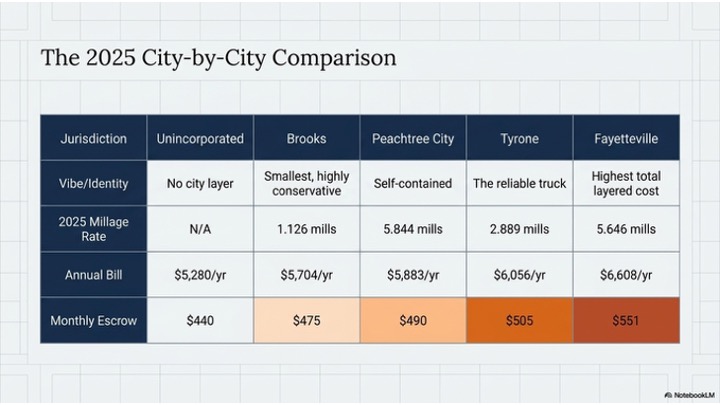
City-by-City Tax Breakdown: $500K Home, 2025 Rates
Here’s what the numbers actually look like, before exemptions, on a $500,000 home in each location in Fayette County.
Unincorporated Fayette County: ~$5,280/year
The baseline. No city tax on top. You pay county M&O, school board, and fire/EMS rates. At 26.4 total mills, unincorporated Fayette is consistently the lowest tax option in the county.
If you’re looking at homes outside any city limits — rural lots, acreage, or subdivisions that aren’t inside a municipality — this is your rate.
Town of Brooks: ~$5,704/year
Brooks is the smallest incorporated community in Fayette County, and town leadership treats taxation as conservatively as you can. The 2025 city millage rate is just 1.0126 mills, a slight decrease from last year’s 1.129. The town took the full rollback specifically to keep taxes flat for residents. The total change in the town’s annual revenue from that decision was approximately $39. That’s not a typo.
If you want the feel of a small town with a tax bill close to unincorporated Fayette, Brooks is worth a serious look. Watch the Brooks breakdown at 12:11.
City of Peachtree City: ~$5,883/year
Peachtree City has its own city millage rate, 6.043 mills for 2025. But here’s where the math gets interesting: residents inside Peachtree City do not pay the county fire and EMS millage. Peachtree City runs its own fire and EMS services, so those costs are covered through the city rate rather than duplicated through the county.
When you account for that, the effective tax burden in Peachtree City lands much closer to unincorporated Fayette than the raw city rate suggests. Buyers who assume Peachtree City is significantly more expensive are often surprised. Daphne breaks down the Peachtree City math at 9:22.
Town of Tyrone: ~$6,056/year
Tyrone’s 2025 city millage rate is 3.433 mills. Combined with county and school rates, residents pay approximately 30.28 total mills. That puts Tyrone between unincorporated Fayette and Fayetteville in total tax burden.
If you want a small-town character with a predictable tax bill, Tyrone makes a strong case. Tyrone breakdown starts at 10:33.
City of Fayetteville: ~$6,608/year
Fayetteville carries the highest total property tax rate in the county. The 2025 city millage rate is 6.06 mills, which combined with county and school rates brings total mills to approximately 33.0.
That said, Fayetteville offers something the other communities don’t: a walkable downtown, city services, and a distinct live-local energy that a lot of buyers specifically want. The buyers I work with who prioritize walkability and proximity to town often land here knowing the tax picture, and they don’t regret it. Fayetteville breakdown at 8:19.
If you’re comparing Fayette County to other South Atlanta suburbs, property taxes vary significantly across the region. My free South Atlanta Relocation Guide includes a county-by-county cost of living comparison — including Coweta County, which I also cover in a dedicated Coweta County property tax breakdown. Download the guide at fayetteliving.com/relocate.
Exemptions for Property Taxes in Fayette County, GA That Can Lower Your Bill Significantly
The numbers above are pre-exemption. For many buyers, especially those 62 and older, the actual bill looks very different.
Standard homestead exemption: Available to all owner-occupants on their primary residence. You must apply, it’s not automatic. The deadline is April 1 of the tax year. This alone provides a meaningful reduction.
Senior exemptions starting at age 62: Qualifying homeowners begin receiving additional school tax reductions. Since the school board rate (17.8 mills) is the single largest component of your bill, even a partial exemption at 62 adds up fast.
100% school tax exemption at age 65: For qualifying seniors, Fayette County offers a full exemption from school taxes. On a $500,000 home, that could reduce your annual bill by well over $3,500, every year. Income and asset thresholds apply and can change year to year, so check with the Fayette County Tax Commissioner’s office for current eligibility.
Disabled veteran homestead exemption: Georgia offers a significant exemption for disabled veterans tied to VA disability rating. At 100% disability, the exemption can reach up to $121,812 of assessed value, a substantial reduction. The exemption also extends to surviving spouses of qualifying veterans. Details on the disabled veteran exemption at 16:22.
To apply for any exemption, visit fayettecountytaxcomm.com. Applications must be submitted by April 1 of the year you want the exemption to apply. You’ll need proof of residency and a government-issued ID.
One more thing worth knowing: you have the right to challenge your assessment if you believe the county has overvalued your home. You have 45 days from the date on your notice of assessment to file an appeal. Before you do, though, understand that a reassessment can go in either direction. If the county comes back with a higher number, your taxes go up. Understanding the full cost of living in Fayetteville GA gives you useful context for making that call.
Property taxes in Fayette County GA are among the lowest in metro Atlanta, ranking sixth lowest when compared to 18 counties of similar size and proximity. If you’re relocating from a higher-tax state, that tends to be a welcome surprise.
But within Fayette County, the difference between cities is $1,300+ per year on a $500K home. That’s worth knowing before you make an offer.
If you want to walk through the numbers on a specific home you’re considering or compare communities side by side, book a free strategy call at talkwithdaphne.com. And if you’re still in the research phase, the South Atlanta Relocation Guide covers everything you need to know about buying in this area — community by community, cost by cost. Download it free at fayetteliving.com/relocate.
About Daphne Bousquet
Daphne Bousquet is a REALTOR® with Real Broker serving the South Atlanta suburbs of Fayette, Coweta, and Henry Counties. She specializes in helping downsizers find the perfect home for their next chapter and guiding relocation buyers through a seamless transition to the area. Whether you’re simplifying your lifestyle or planting new roots, Daphne brings local expertise and personalized service to every move.


Leave a Reply
You must be logged in to post a comment.